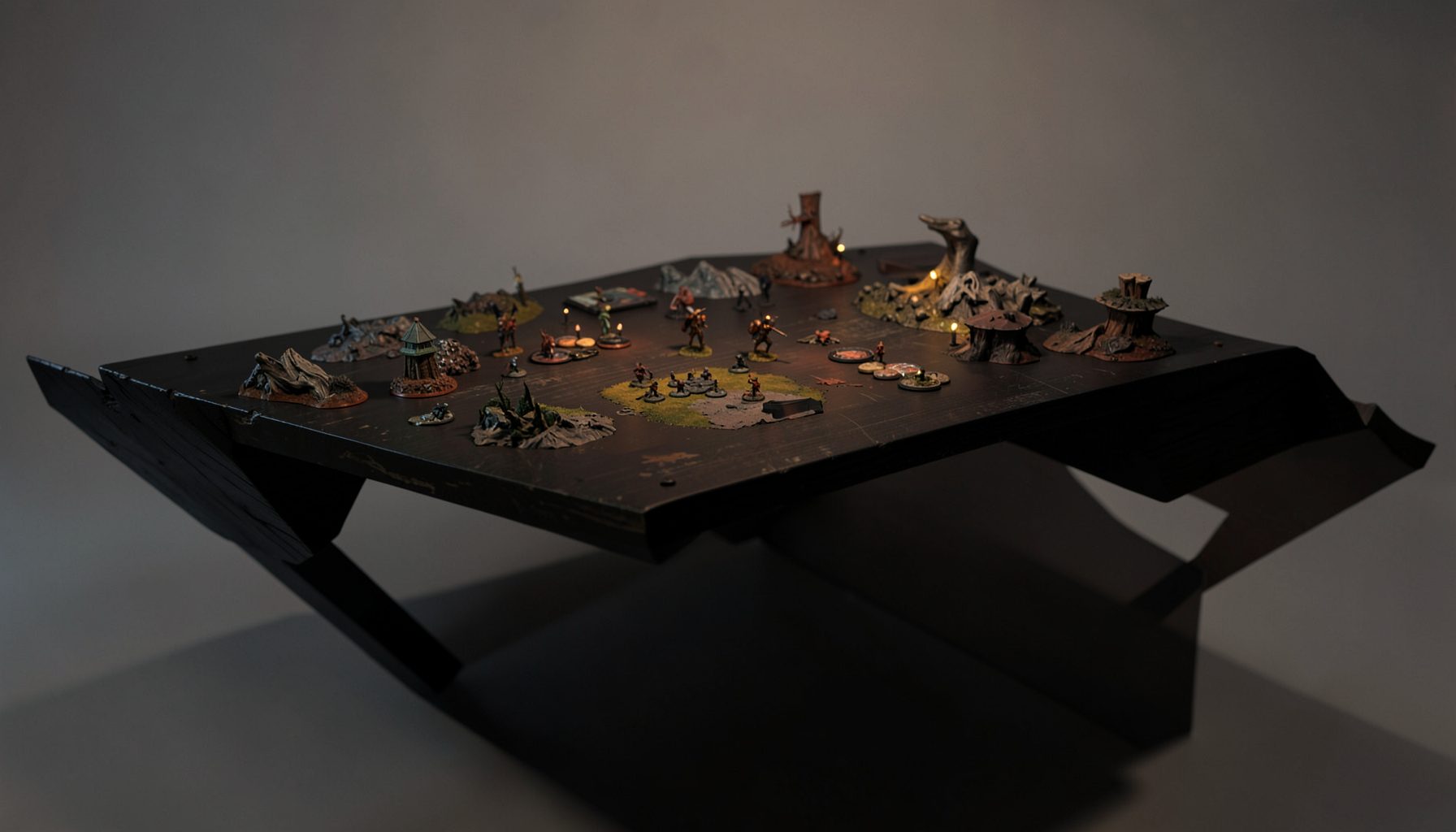
Live-streamed games, recorded matches, and event data gathered in one place.
Kill Team Stream hosts quality live streaming of Kill Team content — tournaments throughout the year on Twitch, regular games streamed to the channel, and tournament data gathered so players can see what's happening in the scene. Powered by WARHAMMER.
Browse tournamentsOfferings
Tournaments
Multiple Kill Team tournaments hosted throughout the year, all live-streamed on our Twitch channel.
Videos
Streams are recorded and uploaded to YouTube alongside original video content we produce.
Event Data
Tournament packets from past events plus resources for upcoming Kill Team tournaments.
Site Directory
The Power of Family Connections in Elucidian Starstriders
The Elucidian Starstriders occupy a distinctive place in the Warhammer 40,000 universe. They are not a conventional Astra Militarum squad, a Space Marine strike team or a group of identical specialists. They are the travelling household of a Rogue Trader, bound together by loyalty, privilege, professional obligation and the long memory of a dynasty that operates far beyond Imperial bureaucracy.
That background matters on the Kill Team table. The Starstriders’ strength comes from how their individual operatives support one another. Their close relationships are represented through command, specialist roles and overlapping abilities rather than a simple family keyword. Understanding those connections helps players appreciate why the team rewards coordinated movement, careful positioning and an aggressive use of limited resources.
A Dynasty Built Around Elucia Vhane
Elucia Vhane is the centre of the Starstrider household. As a Rogue Trader, she represents a hereditary authority that is unusual even within the Imperium. Her power comes from the family’s warrant, reputation and access to a voidship, not merely from rank within a standard military chain of command. She can negotiate, explore, trade and wage war in places where an ordinary Imperial officer would have little freedom.
That makes her more than a conventional leader model. Vhane’s presence gives the team a sense of direction, while her retinue supplies the practical skills needed to survive in hostile territory. The dynasty’s influence is expressed through specialists who protect its interests, maintain its vessel and carry out work that a noble commander would not perform personally.
In narrative terms, the household resembles a travelling business, military unit and extended family at the same time. Some members may be bound by blood, while others are connected through service, debt or personal loyalty. This distinction is important: the power of the Starstriders does not depend on every operative being related. It depends on the household acting as a coherent institution.
The Household Is More Than Bloodline
The term “family connections” can be misleading if it suggests that every Starstrider is a literal relative of Elucia Vhane. The team’s cohesion is broader than that. Imperial dynasties commonly gather retainers, servants, bodyguards, technicians and specialists around a ruling lineage. Over time, those people can become just as important to the household’s identity as the bloodline itself.
The Lectro-Maester, for example, represents the technical and spiritual infrastructure that keeps a voidship functioning. The Voidmaster reflects navigation, command and shipboard expertise, while the Voidsmen provide disciplined manpower. The Rejuvinate Adept brings medical knowledge and the unsettling biological practices associated with maintaining valuable personnel in a dangerous galaxy.
This structure creates an interesting contrast with teams built around a single species or military doctrine. A Starstrider operative may not share a uniform combat style with the rest of the squad, yet each role supports the household’s survival. Their relationships are therefore practical as well as emotional: if the ship’s crew collapses, the dynasty loses its reach; if Vhane is isolated, the retinue’s authority becomes much harder to project.
Individual Specialists Create Collective Power
The team’s rules reward players who see every operative as part of a working network. Vhane offers leadership and command presence, but she is not designed to solve every problem alone. Her bodyguards and specialists extend the team’s influence across the board, allowing the Starstriders to contest objectives, threaten vulnerable targets and preserve momentum.
The assassin-style capabilities of certain operatives create pressure in places the opponent may consider safe. The Lectro-Maester can contribute distinctive ranged or technical effects, while the medic can help preserve the value of an important model. Voidsmen may appear less glamorous than the named characters, but their ability to occupy space and perform mission actions is fundamental to the team’s success.
This is where the household concept becomes a competitive advantage. A player who treats each operative as an isolated duellist will often waste the team’s potential. A player who understands the support chain can make modest models matter. One operative draws attention, another claims an objective, and a third punishes the opponent for moving into the wrong lane.
How Connections Translate Into Kill Team Tactics
| Household connection | Battlefield expression | Practical value |
|---|---|---|
| Vhane and her retinue | Leadership and coordinated activation | Keeps the team functioning around a central plan |
| Voidmaster and Voidsmen | Shipboard command and disciplined manpower | Helps ordinary operatives contribute to mission actions |
| Rejuvinate Adept and key specialists | Medical support and preservation of assets | Protects models that carry crucial abilities |
| Lectro-Maester and technical roles | Specialist utility and unusual threat angles | Adds tools that opponents must respect |
| Household loyalty | Mixed profiles working toward shared objectives | Converts individual weaknesses into team resilience |
The most effective Starstrider turns usually begin with a question of priority: which connection matters most during this turning point? If the mission rewards early objective control, preserving a Voidsman may be more valuable than chasing damage. If an enemy operative threatens Vhane, the household’s protective roles should shape the activation order. The team becomes stronger when the player chooses actions according to the group’s needs rather than personal model preference.
This approach also explains why target selection is so important. Removing the medic, command model or specialist can damage the team’s future turns even when the immediate casualty count looks modest. Competitive opponents often recognise this quickly, so Starstrider players must conceal their most important relationships through cover, screening and carefully planned movement.
The Emotional Weight Behind the Models
The lore of the Starstriders gives ordinary battlefield decisions a stronger narrative charge. A Voidsman is not simply a cheap activation or an objective holder. That model may represent a crew member who has travelled with the dynasty for years, survived boarding actions and understood that loyalty to the household is also a route to protection and status.
The named specialists carry similar weight. They are trusted members of an enclosed community, and a voidship can intensify those relationships. Unlike a planet-based regiment, a ship’s crew cannot easily disperse after a mission. They eat, work, sleep and fight within the same limited environment. Rivalries become personal, while loyalty can become almost hereditary.
For campaign play, this makes the Starstriders particularly rich. A surviving Voidsman might become a veteran whose value exceeds their profile. A wounded specialist may influence future decisions because the team cannot afford to lose their expertise. Even without adding house rules, players can use these relationships to give matches the atmosphere of a dynasty protecting its people across the void.
Strengths and Limits In Competitive Play
The Starstriders’ family structure gives them flexibility, but flexibility is not the same as universal dominance. They have access to a variety of tools, yet each model has a particular job. Their roster can struggle if key specialists are exposed too early or if the player spreads activations without a clear objective plan.
Their mixed nature can also create difficult decisions during list construction and deployment. A powerful operative may tempt a player into an early attack, while the mission demands patience. A large number of useful abilities can encourage overcomplicated turns. The best results usually come from identifying two or three essential relationships before the battle begins and building the opening turns around them.
Against elite teams, the household may need to use numbers, angles and mission play rather than trading models directly. Against horde teams, specialist attacks and leadership tools can help create local advantages, but the Starstriders still need to deny easy objective swings. Their success depends on making the opponent respond to several connected threats instead of allowing the match to become a series of isolated fights.
Reading the Team Through an Australian Tournament Lens
Australian players often face practical conditions that make this kind of flexible team appealing. A tournament in Sydney, Melbourne or Brisbane may draw a varied field, while events in Perth or Adelaide can involve longer travel and a smaller local practice group. A roster that teaches positioning, objective play and threat assessment can provide useful preparation across several matchups.
The local event calendar also affects practice. Games played in Australian Eastern Standard Time are easy to review around evening leagues, and streamed matches can help players compare their decisions with stronger tournament performances. Kill Team Stream’s recorded games are especially useful for studying how a mixed team protects support pieces over several turning points rather than judging it only by dramatic eliminations.
Cost is another consideration. Warhammer models and books can be expensive in the Australian market, with prices at local retailers shaped by importing, distribution and currency conditions. The Starstriders offer a compact force with distinctive models, so they can be attractive to a player who wants a characterful team without collecting a large army. That compact collection also makes it easier to transport models to events in a KR case or other travel storage.
Local gaming culture rewards the team’s narrative identity. At a club night in Melbourne, a tournament weekend in Sydney or a regional event near Brisbane, opponents often appreciate a force that has a strong visual theme and clear story. The Starstriders can deliver that personality while still offering serious competitive depth, provided the player understands that their “family” is a tactical network rather than a licence to make reckless heroic plays.
Building A Stronger Household Narrative
The most satisfying way to play the Elucidian Starstriders is to connect the rules, the models and the story. Before a match, decide who functions as the household’s anchor, who carries the greatest institutional value and which Voidsmen are trusted with dangerous missions. That simple framing can make deployment feel deliberate rather than mechanical.
Painting can reinforce those relationships. Shared colours, matching insignia and small differences in rank help show that the operatives belong to one dynasty without making them look identical. A player might give the Voidmaster more formal markings, use repeated heraldic details on Vhane’s retinue or add subtle signs of shipboard wear to the crew models.
The result is a team whose power comes from connection. Elucia Vhane may stand at the top of the hierarchy, but the dynasty survives through the people around her. On the Kill Team table, that means protecting support, sequencing activations and making every specialist contribute to a common purpose. The Starstriders become most dangerous when the opponent sees separate targets while the player sees a single household moving with shared intent.
Tournament Packets
Packets from previous Kill Team events are kept here alongside new packets for upcoming tournaments, so organizers and players have what they need in one place.
View Event Data