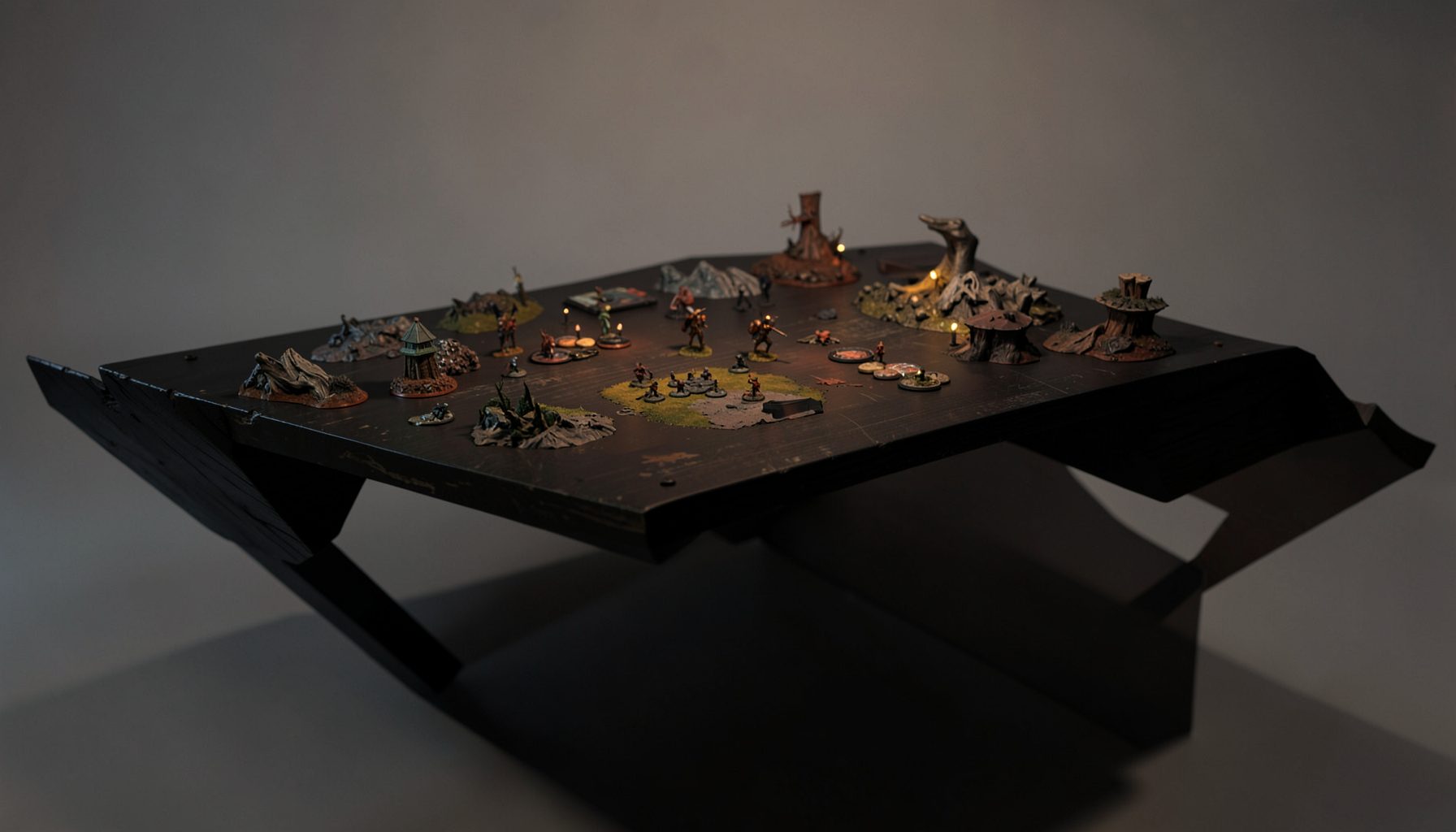
Live-streamed games, recorded matches, and event data gathered in one place.
Kill Team Stream hosts quality live streaming of Kill Team content — tournaments throughout the year on Twitch, regular games streamed to the channel, and tournament data gathered so players can see what's happening in the scene. Powered by WARHAMMER.
Browse tournamentsOfferings
Tournaments
Multiple Kill Team tournaments hosted throughout the year, all live-streamed on our Twitch channel.
Videos
Streams are recorded and uploaded to YouTube alongside original video content we produce.
Event Data
Tournament packets from past events plus resources for upcoming Kill Team tournaments.
Site Directory
Controlling the board with covert and intractable operatives
Winning games in Kill Team rarely comes down to simple kill trades. The teams that consistently place well at events held in Melbourne, Brisbane, and Sydney lean on positional play and reactive decision-making. Two operative keywords that often fly under the radar for newer players are Covert and Intractable. Each reshapes how a player can interact with engagement ranges, and when combined in the right lists they completely rewrite the tempo of a firefight.
Understanding how these rules work and where their edges lie is the difference between being reactive and being reactive on your own terms. The rest of this guide walks through both keywords in detail, the kinds of trades they enable, and how the wider Australian competitive scene tends to deploy them.
What the covert keyword actually allows
Operatives with the Covert keyword ignore one of the oldest restrictions in the game: they can perform Shoot actions even while they are within Engagement Range of enemy fighters. For most units, being in combat ends the possibility of safely firing weapons; a covert operative keeps that option open. They still cannot use weapons that require two hands to wield in the same way, and they still suffer the trade-offs of fighting in a confined space, but the door to ranged output stays ajar.
The first thing to recognise is that this advantage is not about damage stacking on a single opponent. It is about threat projection. A covert operative walking into the middle of a contested objective on a Kill Site such as Killzone: Tomb World can turn around and fire on anyone foolish enough to charge them. If the enemy chooses not to engage, the objective is yours by default. If they do, you shoot first.
This changes how opponents must plan their activation order. Most captains will defer charges past a covert operative, lengthening their own turn and exhausting tactical ploys that were meant for use during a melee rush. At a recent Open-format event at a tabletop store in Parramatta, several players pointed out that simply having two covert operatives on their roster forced opponents to play around them rather than through them. A useful secondary benefit is that covert operatives benefit from cover rules as usual, but they ignore the no-shooting-in-engagement-range clause. Combined with a Concealed ploy or an obscuring terrain piece, they often become priority targets that the opponent must dispatch in melee, wasting precious weapon attacks just to silence one operative.
Punishing overextension with intractable operatives
The Intractable keyword triggers a free Normal Move when an enemy operative ends a Normal Move, Dash, or Charge action within Engagement Range. In plain language, an intractable operative punishes anyone who tries to slip past them. They cannot retaliate with a weapon as part of the trigger, but they can reposition to claim a charge of their own, retreat into cover, or simply block a critical lane.
Consider a Kill Team player trying to slip a fragile leader through a flank to score a Behind Enemy Lines secondary. Walking past an intractable operative hands that player a free dash away from the action and a likely counter-charge next activation. The opponent is now reacting to your response, which is a tempo shift worth more than a single melee swing.
This keyword shines on operatives with strong defensive stats or reliable counter-attack features. Many players from clubs in Adelaide and the Australian Capital Territory pair it with operatives that also carry Ceaseless or Deadly weapons so that the threatened counter-attack becomes a genuine threat to commit to. The free Normal Move is enough to reach a charge if the enemy ends their action at the edge of Engagement Range, but only if the positioning is right at the start of the engagement.
One common mistake is treating Intractable as a defensive crutch. It is more accurately a tool for board control. Each time an enemy ends a movement near an intractable operative, that operative gets to choose one of three responses: spring a counter-charge, pull back into a piece of terrain with a better cover save, or simply relocate to threaten a different lane for next turn. Skilled players rotate between these responses to keep opponents guessing across an entire match.
Building a reactive spine for your kill team
A reactive spine in Kill Team means relying on a few key operatives to answer whatever the opponent does, rather than scripting an aggressive turn in advance. Covert and intractable operatives are two of the cleanest ways to build such a spine, because their rules trigger regardless of which orders you spend elsewhere. Their effectiveness usually outweighs spending action economy on standalone defensive pieces, since the saved actions compound across the match.
In competitive practice, the standard approach is to include one or two covert operatives as mission support, holding the centre while you activate the rest of the team around them. Once a friendly operative secures the third-floor vantage point on a Killzone such as Sanctum or Nexus, the covert operative can roam the middle floor and contest anything that gets close. Saving tactical ploys that improve shooting stats for the moment a covert operative fires in engagement range multiplies the impact of every point spent.
Intractable operatives fit naturally on flanks or near objective markers that must be physically reached. A common structure from teams running in the recent Southern Cross Series brackets was to position an intractable operative behind a heavy piece of terrain on an outer objective. Enemies who try to push through that objective get yanked backward one Normal Move, often falling out of cover for the next friendly activation. Because the move is free, the team's action economy stays untouched.
Mixing the two keywords on the same roster creates layered threats. Place a covert operative forward to discourage melee pushes. Back them up with an intractable operative on a forced path. Opponents now have to choose between a punishing ranged attack or a punishing reposition, and the threat of either often delays the entire attack by an action or two. Realistically, this combination only takes effect in the mid-game, when operatives start clustering on objectives, but by that stage the tempo swing is usually decisive.
Ploy synergies and faction pairings
Strategic and tactical ploys amplify both keywords when chosen with intention. Covert operatives pair well with anything that grants extra AP for shooting, retainers in cover, or re-rolls to hit. Ploys that let you treat an operative as having Concealed even after moving open up long firing lanes that the opponent assumed were closed. Synergies like these are exactly why covert operatives outperform non-covert shooters in extended engagements.
Intractable operatives benefit from ploys that extend the free Normal Move's usefulness. Ploys that add +1 to hit for the first fight after a free move, or that grant a parry-style save, make a counter-charge from an intractable operative a genuine threat to be feared. Some players combine Intractable with equipment that improves charge ranges, allowing the free Normal Move to carry the operative into charge distance more reliably.
Faction lists seen in the Australian metagame often lean into this style. Phobos Strike Teams bring Concealed-Covert combos that frustrate entire game phases. Pathfinders and similar stealthy factions can stack covert operatives with native re-rolls to all but guarantee their shooting outputs. On the Intractable side, several elite melee factions include at least one operative with the keyword as standard, which makes those rosters particularly dangerous to unskilled opponents.
Local preparation matters here. Players in Melbourne frequently run their team drafts at community nights before committing to a list for an event, and these drafts often surface creative combinations that online theory does not. Discussing ploy ordering with teammates across Discord channels or at Friday night games tends to expose which interactions are worth prioritising and which are situational curiosities. Local store regulations around timed rounds also shape how much you can afford to waste on reactive plays, so always confirm the event rules before locking in your ploy picks.
Common missteps and how to avoid them
A handful of mistakes repeatedly trip up players trying to lean on these keywords for the first time. The most common is misreading the free trigger: an intractable operative can only use their free Normal Move after an enemy ends a movement action in their Engagement Range. Charging into them does not trigger it; it is the enemy ending the action that matters. Re-rolling the trigger or trying to fire off the free move mid-charge is the kind of rules slip a vigilant opponent will punish on the spot.
A second mistake is treating Covert as licence to ignore positional play. The operative still needs line of sight, and heavy obscuring terrain still blocks shots. Standing in the open with a covert operative and assuming you will win close-range trades is a quick route to losing half your team. Pair each covert operative with at least one piece of light terrain so you always have a fallback when the dice turn cold.
The third mistake is overstacking the list with reactive pieces. If too many of your operatives trigger on enemy actions, you are left with few proactive threats that can score objectives on your own terms. Two or three such operatives, paired with objective holders and a couple of damage-dealers, tends to be the right balance. Teams built entirely around keywords tend to lose to opponents who simply play the mission by ignoring their lanes and picking up uncontested objectives on the other side of the board.
The final misstep is forgetting to track action economy. A reactive spine usually means your opponent spends more actions responding to your threats, but only if you actually force those responses. Covert operatives force responses by threatening ranged damage in melee. Intractable operatives force responses by threatening a free reposition. If you forget to convert those forced responses into scoring opportunities, the rest of the team will struggle to keep up and your reactive advantage evaporates.
Choosing between them in practice
The right keyword often comes down to mission structure, terrain layout, and the match-up at hand. Players who commit to either keyword from round one usually find that the rest of the list assembles itself around that anchor.
| Aspect | Covert | Intractable |
|---|---|---|
| Core trigger | Shoot action allowed in Engagement Range | Free Normal Move when enemy ends movement within Engagement Range |
| Best role | Threat projection and mid-board control | Flank defence and reactive repositioning |
| Strong against | Opponents who try to charge to silence shooters | Opponents who try to slip past to score tactical missions |
| Weak against | Heavy obscuring terrain and high-damage melee specialists | Opponents who stay at range and avoid Engagement Range |
| Ideal terrain | Open lanes with intermediate cover | Chokepoints and objective markers that must be physically reached |
| Typical ploy pairings | Shooting boosts, re-rolls, Concealed-granting ploys | Counter-charge ploys, parry saves, charge-range equipment |
For a balanced kill team, including one of each tends to be a safe starting point. As the local competitive scene around Brisbane and Perth continues to grow, more players are experimenting with double covert or double intractable builds in mission packs such as Critical Operations, where the mission scoring rewards board control more heavily than straightforward kill trades. Watching how experienced players draft and deploy these specialists in your next local event is often the fastest way to refine your own approach to the keyword game.
Tournament Packets
Packets from previous Kill Team events are kept here alongside new packets for upcoming tournaments, so organizers and players have what they need in one place.
View Event Data