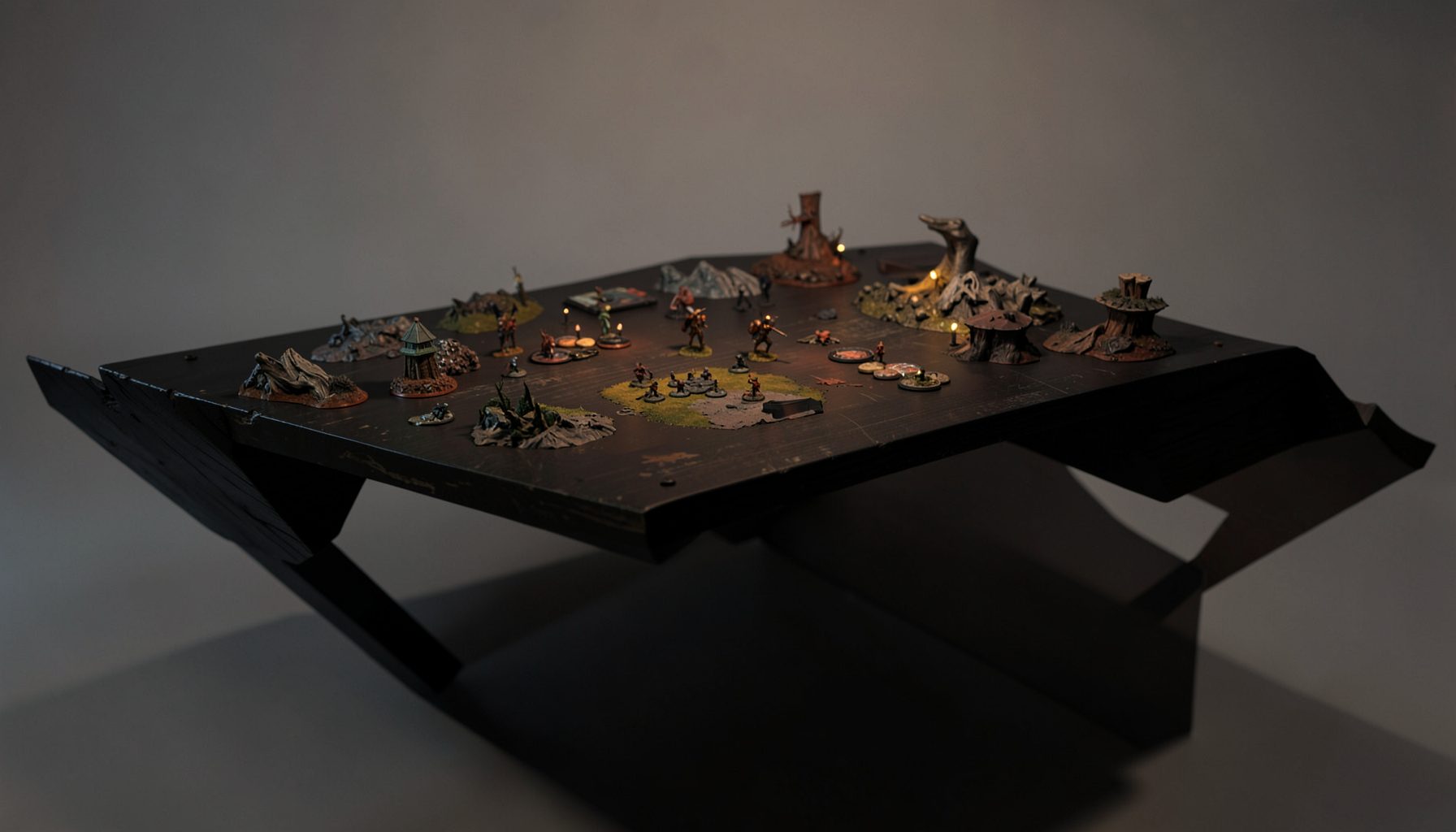
Live-streamed games, recorded matches, and event data gathered in one place.
Kill Team Stream hosts quality live streaming of Kill Team content — tournaments throughout the year on Twitch, regular games streamed to the channel, and tournament data gathered so players can see what's happening in the scene. Powered by WARHAMMER.
Browse tournamentsOfferings
Tournaments
Multiple Kill Team tournaments hosted throughout the year, all live-streamed on our Twitch channel.
Videos
Streams are recorded and uploaded to YouTube alongside original video content we produce.
Event Data
Tournament packets from past events plus resources for upcoming Kill Team tournaments.
Site Directory
How to Score Early With the Covert Action Tac Op
The Covert Action Tac Op rewards a player who can make something happen in the opponent’s half of the killzone before the battle becomes crowded. It looks simple on the card, yet scoring it reliably requires careful planning around movement, mission actions, conceal orders and enemy threat ranges.
Early points matter in Kill Team because the first turning point sets the pace for the rest of the game. A successful covert play can force your opponent to react, open a route towards an objective and give you useful information about where their strongest operatives are positioned.
The best approach is to treat this Tac Op as a timing problem rather than a desperate dash. You need a realistic operative, a safe route and a mission action that can be completed without sacrificing too much of your team. Always check the wording in the current approved rules pack, as card details and mission terminology can change between editions.
Choose The Right Operative Before Deployment
The ideal operative for Covert Action is mobile, reasonably durable and able to reach enemy territory without needing several turns of support. A concealed scout, infiltrator or operative with a free movement ability is often a better candidate than your faction’s strongest fighter. The goal is to complete the required action, not to win a duel in the opponent’s deployment zone.
Look for models with a combination of movement, defensive tricks and reliable positioning. An operative that can move through terrain, ignore certain restrictions or use a dash efficiently may be worth more here than one with superior weapons. In a team such as Kommandos, Pathfinders or Legionaries, the correct choice will depend on the mission layout and the opponent’s ability to punish an isolated model.
During deployment, place this operative where the route to enemy territory is short but not obvious. A central piece of heavy terrain is often better than a flank because it gives access to several lanes. Avoid putting the model directly opposite the enemy’s best shooter. Covert Action is an objective play, and losing the operative before its action is completed can cost both the Tac Op and valuable board control.
The rest of the team should support the route without making the plan too transparent. A durable model can claim a central objective, while a shooter can discourage the opponent from occupying the lane your covert operative needs. If the entire plan depends on one model moving alone, it is probably too fragile.
Plan The First Turning Point Around Distance
Scoring early begins before the first activation. Measure the distance from your deployment zone to the area that counts as enemy territory, then identify every piece of terrain along the route. You want to know whether the operative can reach the trigger location in one turning point, or whether the play needs to be staged over two.
A common sequence is to move into cover during the first activation, remain concealed, and use a later activation to complete the mission action once the enemy has committed elsewhere. This works particularly well when the opponent must choose between advancing towards objectives and hunting your covert operative. The threat of Covert Action can be useful even before it scores because it creates pressure.
Do not spend the first turning point chasing an unrealistic line. If the operative needs a normal move, a dash and an exposed position just to reach the area, the opponent may simply remove it. Instead, use the opening turning point to establish a safe forward position. Early progress is valuable, but an operative that survives to score on the following turn is often more important than a risky first-turn attempt.
The exact activation order matters. Moving your covert operative too early tells the opponent where the play is going. Moving it too late may leave no legal route. In many matchups, the strongest timing is to activate after the enemy has used its main overwatch threat or after a model has stepped away from a blocking position.
Use Concealment And Activation Order
Conceal orders are usually central to this Tac Op. A concealed operative may not be able to fight effectively, but it can cross the killzone without inviting every enemy gun to target it. Terrain should block lines of sight wherever possible, especially from weapons with long range or high damage.
A useful pattern is to make the opponent solve two problems at once. One friendly operative can threaten a normal objective, while the Covert Action operative approaches from a different angle. If the opponent turns several models towards the covert route, your other operatives gain room to score. If they ignore it, your mission action becomes safer.
Activation order also protects the action. Keep a nearby operative ready to remove an enemy that moves into the route, or use a specialist to create a temporary threat that your opponent cannot ignore. Some factions can provide smoke, indirect fire, psychic protection or command-point effects that make the final approach safer. Spend these resources when they secure a point, rather than using them automatically in the opening exchange.
Be cautious with free actions and mission actions that compete for the same activation. A model may appear to have enough movement to reach the target, but a mandatory interaction, climb or traverse can change the calculation. Check whether the action requires the operative to be in a particular location, whether it can be performed while concealed and whether an enemy model can interrupt the plan.
Make The Enemy React To Your Threat
Covert Action is strongest when the opponent cannot simply screen the target with one cheap operative. Present several credible threats at once. Push a combat specialist towards a central objective, place a shooter where it can punish a defensive move and keep the covert operative concealed behind terrain. This forces the opponent to decide which problem deserves attention.
Understanding the enemy’s threat range is essential. A model may not need line of sight to stop your plan if it can charge, move onto the relevant area or perform a mission action first. Measure normal movement, dash distance and any faction-specific abilities before committing. A fast enemy team can make a first-turn score impossible, while a slow elite team may struggle to interfere once you reach the correct position.
If the opponent sends a model to block your route, do not automatically fight through it. Sometimes the correct response is to change the scoring turn and use the covert operative as a passive threat. You can then score primary objectives elsewhere while the enemy wastes activations guarding an area that is no longer your immediate target.
This pressure is especially useful in Australian events, where terrain and table layouts can vary noticeably between clubs in Sydney, Melbourne, Brisbane and Perth. A strategy that works on dense indoor terrain may fail on a more open tournament table. Reviewing event photos and packets before travelling can help you understand whether Covert Action is likely to be a realistic early play.
Avoid Trading The Point For Too Much
The first point is valuable, but it should not cost half your team. Before attempting the action, compare the likely reward with the opponent’s possible counterplay. If scoring leaves the operative exposed to a guaranteed charge or several high-quality shots, calculate whether the rest of your turn can compensate.
A good score often comes with an exit plan. The operative should be able to move back into cover, occupy a useful objective or force the opponent to spend an activation dealing with it. If it completes the action and then stands in the open, the point may still be correct, but you need to know what you are giving up.
Track the battle score and turning-point sequence carefully. Covert Action can tempt players into taking a dramatic route when a simpler primary score would produce the same advantage. Use a token or note beside the operative so the intended action is not forgotten after several combats. Competitive games become busy, particularly in a timed round at a large Australian event.
Before a tournament, study recent results and mission packs through event results so you can compare how different teams approach early scoring. Watching recorded matches from the Australian scene is also useful because experienced players often reveal when a Tac Op was selected as a genuine plan and when it was merely chosen because other options were worse.
Practise The Route Before Game Day
The most reliable preparation is a short set-up drill. Place a representative killzone on the table, mark the enemy territory line and test the operative’s route under several deployment arrangements. Repeat the exercise with the model starting behind heavy cover, on a flank and near the centre. Record which routes require a dash and which leave the operative exposed.
Practise the opponent’s likely responses as well. Put a fast enemy model near the centre, then test whether your operative can still reach the scoring position. Add a long-range shooter and check whether a concealed approach remains legal. These drills turn a vague idea into a reliable activation sequence and reveal when Covert Action should be delayed.
Australian players also need to account for event logistics. Long trips between states, early starts and compact round schedules can make small rules errors more likely. Keep the current Tac Op card, mission pack and a measuring tool beside the table, and use clear language such as “I am revealing this now” before carrying out the action. At a relaxed club night, people may say “no worries” and rewind a mistake; at a streamed tournament, precise timing protects both players.
The key is flexibility. Select a suitable operative, prepare a safe route, use concealment to control the timing and make the opponent respect several threats. When the opportunity is clean, score early. When it is not, preserve the operative and convert the pressure into primary points. Covert Action rewards disciplined board play far more consistently than a reckless rush into enemy territory.
Tournament Packets
Packets from previous Kill Team events are kept here alongside new packets for upcoming tournaments, so organizers and players have what they need in one place.
View Event Data