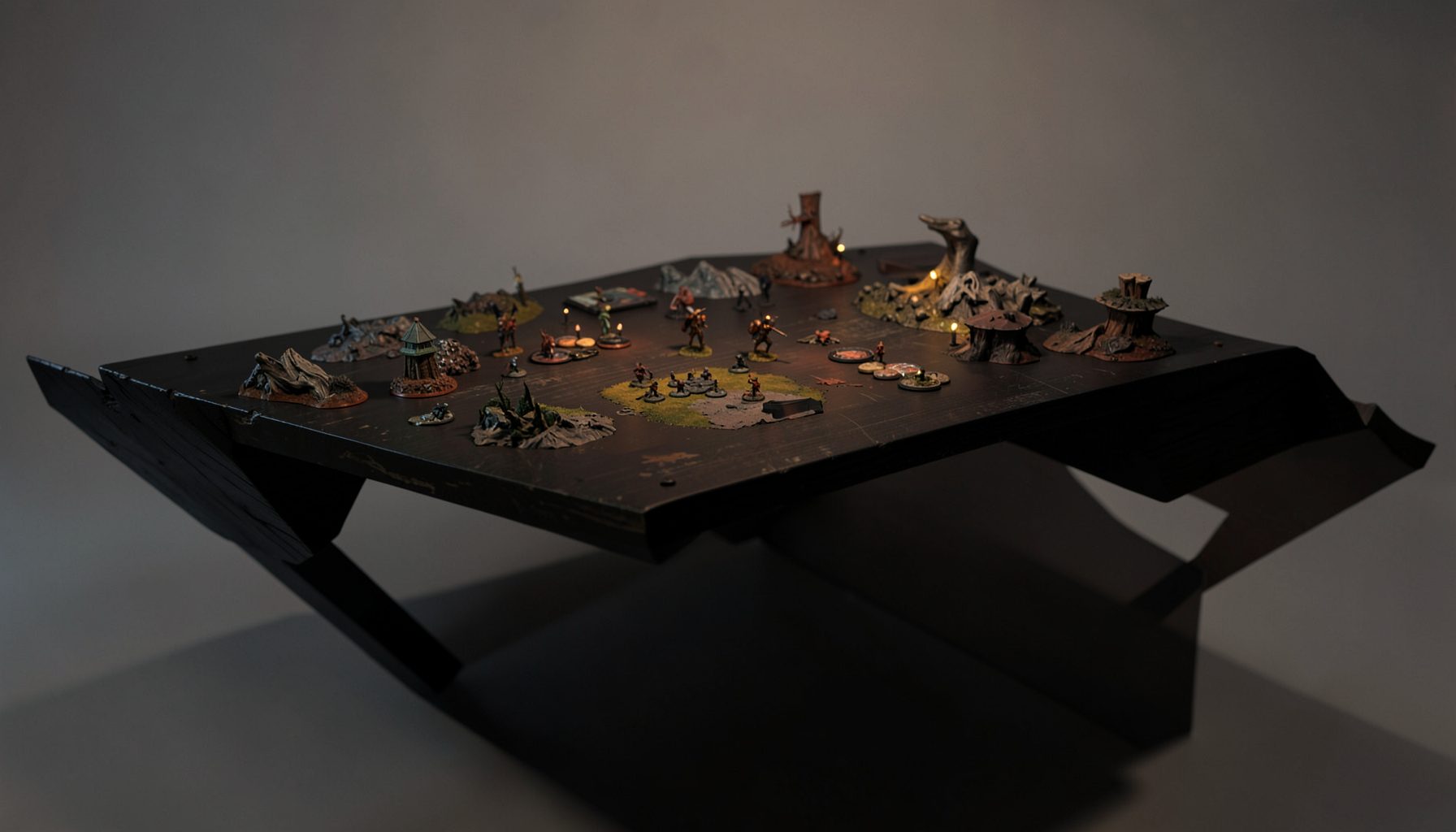
Live-streamed games, recorded matches, and event data gathered in one place.
Kill Team Stream hosts quality live streaming of Kill Team content — tournaments throughout the year on Twitch, regular games streamed to the channel, and tournament data gathered so players can see what's happening in the scene. Powered by WARHAMMER.
Browse tournamentsOfferings
Tournaments
Multiple Kill Team tournaments hosted throughout the year, all live-streamed on our Twitch channel.
Videos
Streams are recorded and uploaded to YouTube alongside original video content we produce.
Event Data
Tournament packets from past events plus resources for upcoming Kill Team tournaments.
Site Directory
How terrain density shapes Kill Team list building decisions
Kill Team has always rewarded players who think beyond their datasheets. The 2024 edition doubled down on that philosophy by tying every match to a specific terrain layout and mission combination, which means roster construction now starts with the gaming environment rather than with the faction you love. Before you settle on operatives, you have to read the room, and the walls, the ruins, the crates, and the sightlines matter as much as the weapons your team is carrying.
Across Australia, the tournament scene has matured into something distinct from the European or North American metas. Brisbane, Melbourne, and Sydney clubs tend to favour dense, narrative boards packed with Sector Mechanicus ruins, while Perth and Adelaide organisers often run slightly looser layouts to speed up round times during long weekend events. That regional texture shapes what works on the day. A list tuned for a tightly packed Sydney GT may flounder in an open Adelaide hall, even when the mission pack is identical.
Players who ignore the geography of the board tend to find themselves cornered, out-ranged, or simply out-paced. The good news is that reading terrain density is a learnable skill, and the pay-off shows up immediately in matchups. The next few sections walk through how battlefield layouts influence operative selection, weapon loadouts, and even the order in which you queue your ploys.
Understanding why terrain density matters also helps you argue your case in list reviews. When you can point to a specific wall, sightline, or ruin feature and explain how your roster interacts with it, your decisions stop looking arbitrary and start looking like a coherent plan. That clarity is what separates the average attendee from the players who regularly podium at events like the Brisbane Swordfall or the Melbourne Mid-Year Major.
Reading terrain density before you pick operatives
The first question to ask is not "who do I want to play" but "how many Obscured and Cover positions does this board offer?" A dense layout, the kind you typically encounter at clubs using full Sector Mechanicus walls and the Killzone Nachmund or Bheta-Decima boxes, gives every faction a fighting chance with melee specialists and short-range gunners. A sparse layout, with only a few central ruins and wide open flanks, tilts the math toward shooty teams that can hold objectives with volume of fire.
Kill Team missions from the current Battlezone deck assign terrain features to specific tactical rules. Many missions award bonus VP for holding objectives in Cover, or punish teams that fail to control the centre. If the board has eight major pieces and a dozen crates, the value of a stealth operative with a silenced pistol spikes. If the board has only three ruins and a long diagonal corridor, you want operatives with longer range bands and the means to push opponents off the centre.
Australian events often publish their terrain manifests in advance, which is a luxury players at casual local game nights do not get. The Brisbane RTT series and the Canberra Open both post pack photos and stand layouts on their Discord servers a week out, so a prepared player can practice with proxy terrain at home. Use that window. A model spent mimicking the tournament setup is worth a dozen list-theory articles.
The third dimension to read is verticality. Some boards, particularly those built around the Morochi or Volkus killzone, include gantries, walkways, and elevated platforms that change the way operatives move. A list with only ground-pounders suddenly finds itself staring up at an enemy that controls all the high angles. Always count the elevated positions before you lock your roster.
Dense boards and the rise of aggressive play
Tournament reports from the past twelve months tell a clear story: dense terrain has rewarded aggressive play. Factions like Wyrmblade, Corsair Voidreavers, and the Hunter Clade have thrived on layouts where you can break line of sight two moves after deployment. Their ability to flip from ranged shooting to close combat in a single activation catches opponents flat-footed in cover-heavy boards.
This is the meta most Australian clubs default to. A quick look at the terrain in any Good Games store from Sydney to Perth confirms it, and the community has invested heavily in full ruin sets and dense industrial layouts. That decision shapes the local competitive tier list in ways that international rankings sometimes miss. A team that dominates UK events on sparse boards can underperform here simply because the geography refuses to give them open lanes.
Players building lists for dense boards should prioritise operatives with Ploy-friendly melee profiles and easy access to conceal conditions. Breachers, Legionary gunners with chainswords, and Pathfinders with carbines are all strong picks because they can pivot between fighting and shooting without losing tempo. Remember to bolt on a Combat or Factional ploy that rewards staying in Cover, since your opponent will struggle to remove you if they cannot draw a clear line.
One practical tip from the Australian scene is to bring a printed copy of the terrain manifest and mark which lines of sight are blocked from each deployment zone. Doing this the night before a tournament saves you from arguing with your opponent during a game about whether a particular gantry blocks a charge or not. It also helps you adjust your list on the fly if you realise your planned strategy depends on sightlines that simply do not exist.
Open boards and the long-range calculation
Open boards flip the script. When the terrain is sparse, objectives become kill zones and the team that can fire further tends to dictate the engagement. This is where shooty kill teams such as the Imperial Navy Breachers, the Kasrkin, and the Kastelan-heavy Mechanicus rosters show their value. Their long-range weapons and faction ploys that reward stationary firing make them naturals for wide-open halls.
The challenge with open boards is movement. If you cannot break line of sight behind a wall, every dash across open ground risks eating two or three overwatch shots. Lists built for these conditions tend to include operatives that ignore the movement penalty for advancing and shooting, with the classic example being the Kasrkin Hot-shot Volley Gun profile, or any team with the Balanced or Heavy keywords that gain accuracy from standing still.
Open boards also favour teams that can deploy hidden, because there are fewer places to hide. The Infiltrate and Scout actions shine when the only pieces of terrain are two central ruins and a corner barricade. A list that includes even one or two operatives with deep deployment options suddenly has a free hand to dictate the first activation. Watch how the top Australian players set up their open-board lists and you will notice the same pattern: forward deploy, secure an early position, and bleed the opponent's activations.
There is a counter-intuitive upside to open boards too. Melee teams suffer, but they can still win if they can force a single decisive clash. A list with one or two dedicated melee threats, backed by a screen of shooty operatives that just need to hold the centre, can catch a shooty opponent off guard when they over-extend. The key is knowing which of your operatives can make that trade worth taking.
Here is a quick comparison of how list building priorities shift between dense and open terrain layouts:
| List Building Priority | Dense Terrain | Open Terrain |
|---|---|---|
| Operative Selection | Melee-focused with conceal options | Long-range specialists with stationary buffs |
| Weapon Loadouts | Short range, high damage profiles | Mid-to-long range with Blast or Torrent |
| Ploy Investment | Ploys that reward Cover or Obscured | Ploys that reward stationary firing or shooting |
| Deployment Strategy | Spread deploy to break sightlines | Forward deploy to contest objectives early |
| Objective Play | Hold contesting zones in ruins | Hold open centre with overlapping fire lanes |
| Vulnerability | Struggles vs mobile shooty teams | Struggles vs fast melee or concealed infiltrators |
This table is not exhaustive, but it captures the main trade-offs you should be weighing the night before an event. Bookmark it, print it, or scribble it in your list-building notebook, since it is the kind of reference that pays off across an entire tournament season.
Reading mission packs and their interaction with layouts
The mission pack is the silent partner to terrain density. A mission that rewards holding the centre benefits dense boards, where the centre is naturally defensible. A mission that rewards spreading operatives across four corners rewards open boards, where long-range fire can cover multiple objectives. Treating the mission pack as an afterthought is the fastest way to design a list that wins on paper and loses on the table.
Recent Australian events have leaned heavily on the official Chapter Approved missions, but a growing number of TOs are running custom packs that reflect local play preferences. The Canberra Masters, for example, uses a modified Tac Ops list that scores extra VP for securing ruins. The Brisbane Cup favours missions with more open objectives. Reading both the official terrain manifest and the custom mission rules together is essential, and the best players do both weeks before the event.
When you study a mission, look for three things: how VP is scored, when it is scored, and which operatives are best positioned to score it. If the VP is scored at the end of the turning point, holding an objective becomes more important than killing. If the VP is scored during, mobility becomes king. If the VP is scored only on certain rounds, you can plan a tempo shift in your roster that focuses on a specific phase of the game.
A useful exercise is to write out your team's expected VP across every mission in the pack, using the terrain you expect to play on. Players who do this consistently find that their list suddenly makes more sense, with every operative carrying a job, every ploy triggering at the right moment, and every weapon finding a target. It also exposes dead weight in your roster, which is much easier to cut at home than mid-event when the pressure is on.
Adapting your roster for Australian tournament norms
Australian tournaments have their own quirks. Round timings are typically two hours rather than the international standard of two-and-a-half, which favours faster lists and punishes slow, ploy-heavy factions. Our summer heat pushes many events into air-conditioned venues, but winter weekends still see a few outdoor clubs running games on verandahs with improvised terrain. Either way, local players tend to know exactly which terrain configuration to expect.
Down time between rounds matters more than people admit. A long tournament day can run eight hours, and you will have stretches where you are waiting for the next pairing or stuck between tables during a top cut. Bringing a small distraction for those moments is a survival tactic, and a casual browser game between rounds can reset your focus and stop you from tilting into your next match. Just make sure it does not eat into your prep time.
Culturally, the Australian scene is more relaxed than the European or American circuits. Players will call you "mate" regardless of the result, the canteen will serve meat pies and sausage rolls at most venues, and the post-game chat is almost always longer than the game itself. That atmosphere is a feature rather than a bug, but it also means list decisions can drift towards flavour picks. Resist the temptation. The competitive edge still belongs to the player who treats terrain and missions as the foundation of every roster decision.
Budget matters too. With the Australian dollar doing what it does, picking up three boxes of a kit that ends up gathering dust in a cupboard is a real cost. Build for the terrain and missions you will actually face, not the meta you wish you played in. The Kill Team scene in this country rewards the player who adapts, and that adaptation starts with reading the board before you read the datasheet.
Tournament Packets
Packets from previous Kill Team events are kept here alongside new packets for upcoming tournaments, so organizers and players have what they need in one place.
View Event Data