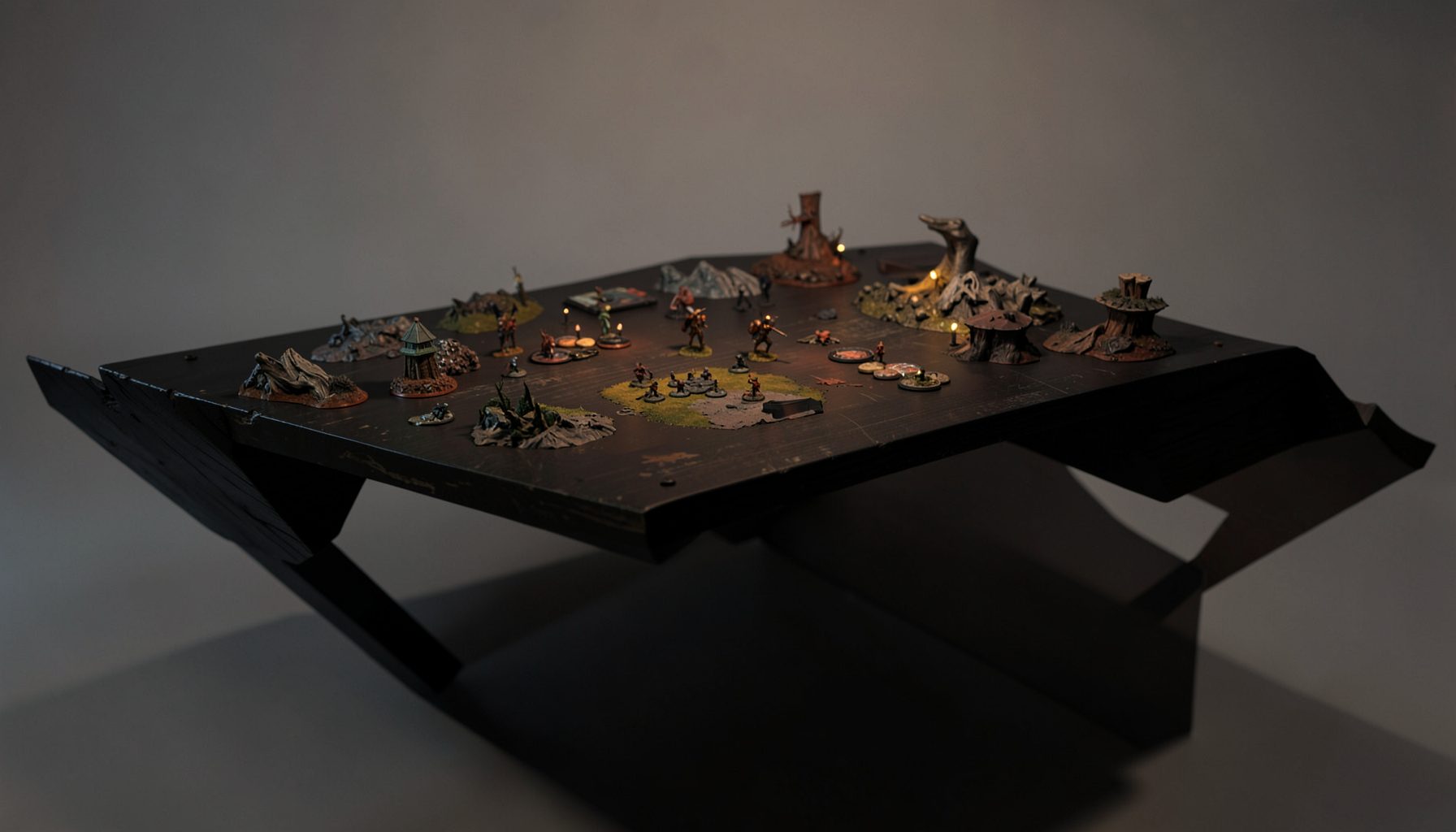
Live-streamed games, recorded matches, and event data gathered in one place.
Kill Team Stream hosts quality live streaming of Kill Team content — tournaments throughout the year on Twitch, regular games streamed to the channel, and tournament data gathered so players can see what's happening in the scene. Powered by WARHAMMER.
Browse tournamentsOfferings
Tournaments
Multiple Kill Team tournaments hosted throughout the year, all live-streamed on our Twitch channel.
Videos
Streams are recorded and uploaded to YouTube alongside original video content we produce.
Event Data
Tournament packets from past events plus resources for upcoming Kill Team tournaments.
Site Directory
Reading the Board Through Tac Ops Cards in Kill Team
Tac Ops sit at the heart of every competitive match in Warhammer Kill Team, shaping how players construct their killteams, position their operatives, and decide when to commit resources. They are the secret objectives you select at the start of the game, revealed only when scored or triggered, and they reward specific tactical behaviours that often have nothing to do with simply killing the opposing force. For Australian players tuning in to Kill Team Stream broadcasts from Melbourne hobby stores or following the leaderboards after a Brisbane heat, understanding how each card scores is the difference between finishing the round at six VP and walking away with a respectable ten.
Every killteam brings a hand of Tac Ops drawn from a faction-specific pool, and the cards fall into four broad archetypes: Security, Recon, Seek and Destroy, and Infiltration. Each archetype encourages a particular style of play, and the highest-scoring cards in each suit often demand setup across multiple turns. Reading which cards your opponent might be holding, and predicting when they will flip, is a skill that takes months of rep at the tabletop to develop, but it can be broken down into a few reliable principles that anyone watching or playing the game can apply.
The Hidden Economy of Secondary Scoring
Tac Ops function as the secondary economy layered on top of Primary scoring, which itself rewards holding objectives in certain phases. Where Primary scoring punishes a player for being absent from the centre of the board, Tac Ops give a trailing player a route back into the match. A killteam that loses the Primary race by two VP at the end of turn two can still win on total score if two of its hidden cards drop in the final turning point. This creates a built-in catch-up mechanism that the tournament scene, including the regular Sydney weeknight events and the Australian Grand Tournament circuit, has spent the last few seasons learning to exploit.
The real cost of a Tac Op is not points on the table but the operational tempo it demands. Cards that reward planting a banner in enemy territory force your operatives into exposed positions, while cards that require killing specific operative types often waste a turn's shooting on a target you would otherwise ignore. Players in competitive Melbourne crews have started referring to this trade-off as opportunity cost, and the term has spread through stream chats faster than any new FAQ. Learning to weigh the action you take against the card it might feed is the first step to scoring reliably.
Security Cards and the Slow Grind
Security archetype Tac Ops reward players who can hold ground, complete actions over multiple activations, and survive being shot at. Cards such as Rout, Recover, and Plant Banner belong to this category, and they typically offer between one and three VP depending on timing windows. Plant Banner in particular has shaped a generation of faction matchups because the moment you reveal it, your opponent immediately understands that your operative was never supposed to be in a fight at all. He was on a delivery run.
The grind nature of Security cards means they pair naturally with killteams built on durable, action-efficient operatives. Veterans running Votann or Deathwatch lists at the Brisbane Tabletop Championships have built entire opening sequences around scoring Recover on turning point one, banking that early VP while their opponent chases Primary points. The risk is that a failed action can leave you a full turn behind, so the cards reward patience over aggression and demand that you measure your positioning in centimetres, not activations.
Recon Cards and Map Control
Recon cards ask a different question of your killteam: can you put operatives in specific places at specific times? Cards like Seize Position, Mark Position, and Scout demand mobility and a clear plan for which operatives will move where in each turning point. They tend to score two VP at most, which sounds modest until you realise that a successful Recon turn gives you Primary scoring flexibility at the same time.
Streamers covering Sydney events often point out that Recon cards are the easiest category to bluff. Because the condition is met by simply being in the right spot, an opponent cannot tell whether you are playing for Primary or whether you are about to reveal a Seize Position drop behind their lines. This information fog is itself a weapon. Veteran players at Melbourne's Good Games stores have refined the habit of moving an operative to a corner location with no apparent reason, forcing the opponent to spend resources watching them rather than pursuing their own Tac Ops.
Seek and Destroy Cards and the Kill Economy
The Seek and Destroy archetype is the most straightforward to read but the hardest to score consistently. Cards such as Mark Target, Cull, and Slay the Leader reward killing specific operatives, often with modifiers like outside six inches of another friendly operative or during a specific turning point. They pay two or three VP, and they ask a simple tactical question: can your killteam find the right target at the right moment?
The Australian competitive scene treats these cards as a tiebreaker between equally skilled players, because the difference between a kill secured on activation three and a kill secured on activation six is the difference between a card scored and a card abandoned. Perth crews running heavy-hitter teams like Wrecka Krew or Wyrmblade have leaned into Cull as a win condition, banking on the fact that their alpha-strike profile naturally fits the card's condition. For slower, objective-focused factions, the same card is often left unsized in favour of a more achievable Secondary.
| Archetype | Example Card | Typical VP | Difficulty | Best Window |
|---|---|---|---|---|
| Security | Plant Banner | 2 | Medium | Turning Point 2 |
| Security | Recover | 1 | Low | Turning Point 1 |
| Recon | Seize Position | 2 | Medium | Turning Point 3 |
| Recon | Scout | 1 | Low | Turning Point 2 |
| Seek and Destroy | Mark Target | 2 | Medium | Turning Point 2 |
| Seek and Destroy | Cull | 3 | High | Turning Point 3 |
| Infiltration | Plant Device | 3 | High | Turning Point 2 |
| Infiltration | Steal | 2 | Medium | Turning Point 3 |
Infiltration Cards and the High-Reward Play
Infiltration cards are the risk-takers of the deck. Plant Device, Steal, and Sabotage reward actions performed behind enemy lines, often on the opponent's side of the table, and they pay out two or three VP for a single decisive moment. They also produce the most dramatic reveals in streamed matches, because the card flips on the same activation that completes the action, and the chat always reacts to the surprise.
Tournament players in Adelaide and Hobart have built reputations around playing Infiltration cards aggressively, using cover saves and faction abilities to push operatives into the opponent's deployment zone without dying on the way in. The cards demand a killteam with a reliable action monkey, an operative that can survive one turn of return fire, and a backup plan for when the plan goes sideways. For newer players watching the game on YouTube after an arvo session, Infiltration cards are the clearest illustration of how Tac Ops reward commitment over caution.
Reading Opponent Signals and Card Windows
Every Tac Op card has a trigger window, and learning to read when an opponent is fishing for a card is half the battle. A player who moves an operative out of cover for no tactical reason is usually trying to score a positional card, while a player who suddenly switches targets mid-turn is usually chasing a kill-based card. Streamers commentating on Sydney's regular Tuesday night events often highlight these tells in real time, and the habit of watching for them transfers directly into your own games.
The second layer of reading is predicting which cards an opponent cannot score. If their killteam lacks an operative with a free action, Plant Device is unlikely to be in their hand. If their faction cannot deep strike or infiltrate, Seize Position loses much of its value. Cutting cards from an opponent's likely pool narrows your defensive planning, and it gives you permission to ignore threats that look dangerous but cannot actually flip. This is where experienced players at the Australian Open Series and similar circuits pull away from the field, because they play the meta of Tac Ops as much as they play the operatives on the table.
Pairing Cards With Faction Selection
The final piece of the puzzle is choosing a killteam whose operatives naturally align with the Tac Ops you want to score. A faction with strong action economy, such as the Greater Thurian League or Novitiates, makes Security cards effortless, while a faction with deep-strike and infiltration tools makes Infiltration cards achievable on the first turning point. Players building lists at local Aussie tournaments tend to select two cards from their strongest archetype and one flex pick from a second archetype, banking on the flex card to cover a bad matchup or a missed scoring window.
Kill Team Stream's commentary team has tracked this trend across multiple seasons, and the data suggests that killteams running mixed archetypes score slightly higher on average than killteams committing to a single suit. The reason is variance: a single missed card can swing a match, so spreading your scoring sources reduces the chance of a complete washout. Whether you are streaming from a Brisbane games cafe, a Melbourne hobby store, or your own shed out the back, the principle holds: choose Tac Ops that fit your killteam's strengths, leave the rest in the deck, and trust the primaries to carry the rest.
Tournament Packets
Packets from previous Kill Team events are kept here alongside new packets for upcoming tournaments, so organizers and players have what they need in one place.
View Event Data