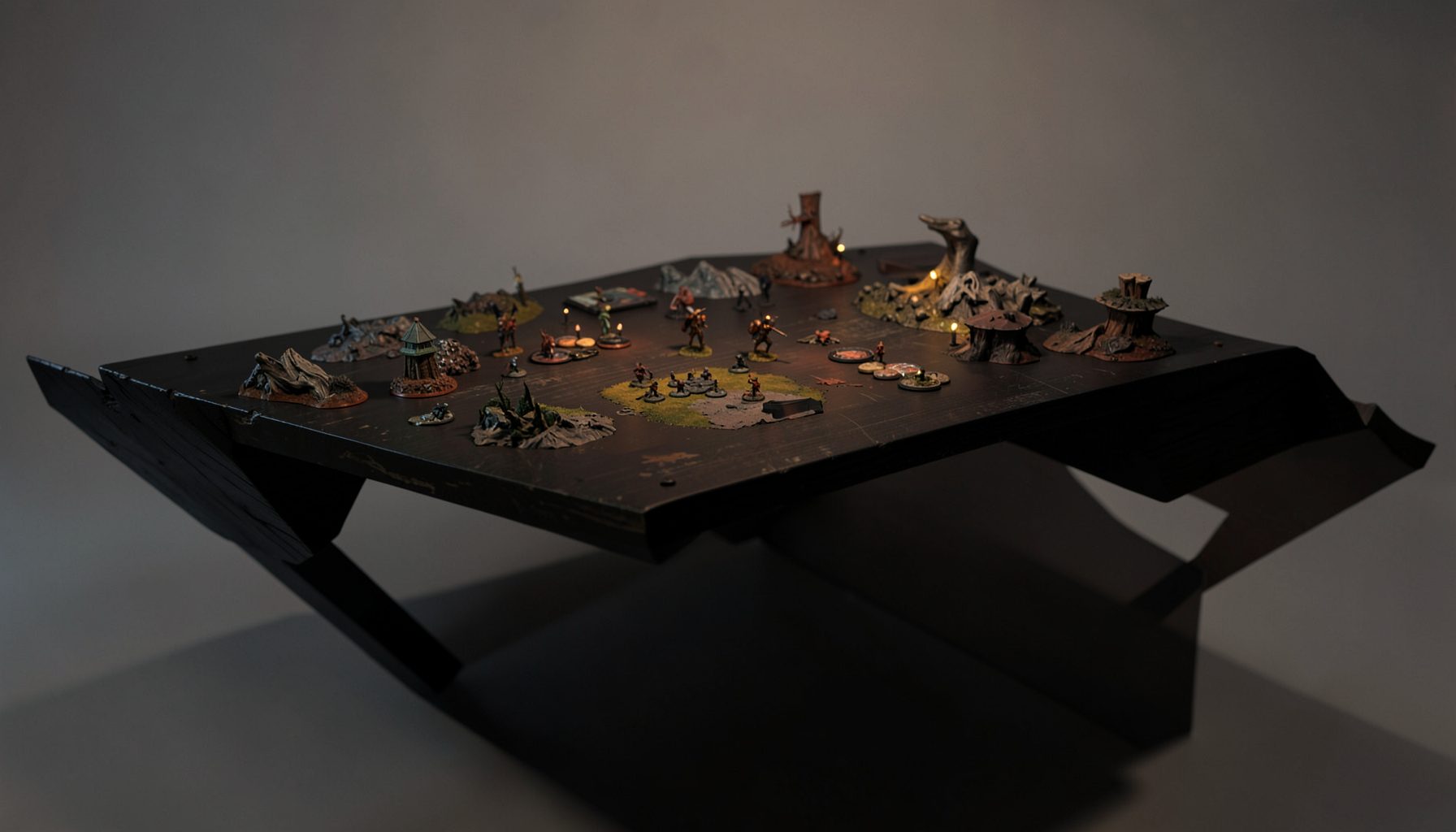
Live-streamed games, recorded matches, and event data gathered in one place.
Kill Team Stream hosts quality live streaming of Kill Team content — tournaments throughout the year on Twitch, regular games streamed to the channel, and tournament data gathered so players can see what's happening in the scene. Powered by WARHAMMER.
Browse tournamentsOfferings
Tournaments
Multiple Kill Team tournaments hosted throughout the year, all live-streamed on our Twitch channel.
Videos
Streams are recorded and uploaded to YouTube alongside original video content we produce.
Event Data
Tournament packets from past events plus resources for upcoming Kill Team tournaments.
Site Directory
Why Corsair Voidscarred Can Surprise the Kill Team Meta
The Corsair Voidscarred occupy an interesting place in the Kill Team competitive landscape. They are not usually the first Aeldari team discussed when players compare tournament winners, yet they have the tools to punish opponents who underestimate speed, angles and flexible activation choices. In the hands of a player who understands positioning, this team can turn a seemingly safe board into a network of threats.
Their reputation as a difficult or inconsistent faction partly hides their strengths. Corsairs reward planning several actions ahead, careful use of cover and a willingness to score points rather than chase dramatic eliminations. That combination makes them a sleeper pick: a team that may not dominate every matchup, but can perform extremely well when piloted with discipline and selected for the right mission and terrain.
Speed That Creates Real Board Control
The Corsair Voidscarred’s most obvious advantage is mobility. Their operatives can reposition quickly, take unusual routes and threaten objectives from distances that many opponents misjudge. Movement is valuable in Kill Team because every inch affects line of sight, charge ranges, cover and the ability to contest an objective. Corsairs convert that value into pressure from the first turning point.
This mobility is more than simply moving farther than another operative. A Corsair player can create several possible threats at once, forcing the opponent to decide which lane deserves protection. A gunner may hold a firing angle while a specialist moves toward a central objective, and a melee operative can remain concealed until an exposed target appears. The opponent is often pushed into reactive play, spending actions to prevent attacks rather than advancing their own plan.
The team is especially comfortable on boards with dense terrain and multiple routes between objectives. They do not always need a direct line across the table; they benefit from side paths, elevated positions and areas where a fast operative can disappear after completing an action. On open layouts, their speed can still matter, but the quality of cover becomes more important because fragile Aeldari models cannot afford to absorb unnecessary return fire.
A Roster Built Around Specialist Threats
Corsairs have a broad roster of specialists, and that breadth is one reason their performance can look better in expert hands than on a simple faction summary. The team can bring tools for ranged pressure, close combat, objective play and utility actions. Selecting the right operatives is a significant part of the game, especially when the opponent’s faction and the mission are known before deployment.
The heavy gunner offers a way to make an enemy respect a firing lane, while the Fate Dealer can provide useful ranged accuracy and pressure when positioned carefully. The Kurnathi brings a distinct melee threat, and the Shade can exploit concealment and positioning to reach vulnerable targets. Other operatives contribute speed, support or mission actions rather than raw damage. The strongest roster is rarely built around one superstar; it is built around several pieces that force difficult decisions.
This variety also makes the faction less predictable in a tournament setting. An opponent preparing for a purely evasive Corsair game may be surprised by a more aggressive setup, while a player expecting a melee rush may struggle against patient ranged play. The key is avoiding the temptation to activate the most exciting model first. Corsair specialists work best when their actions support one another and preserve options for later activations.
Why Their Weaknesses Are Easy To Misread
The team’s weaknesses are real. Many Corsair operatives are vulnerable when caught in the open, and a poor early move can expose a model before it has delivered meaningful value. Their damage output can also feel uneven if the player relies on a single attack sequence or fails to coordinate shooting with movement. A fragile elite-style piece that loses an operative early may leave the team short of options.
That fragility encourages a different approach to trading. Corsairs should rarely exchange models simply because an enemy is within reach. A good trade removes a key opposing threat, secures an objective or creates a scoring advantage that lasts into the next turning point. If a Kurnathi eliminates a valuable enemy but is then stranded in the open, the exchange may still be poor. The operative’s exit route matters almost as much as the attack itself.
Their psychic and tactical tools can also be overvalued. A clever ability does not replace sound positioning, and an attractive ploy may be less important than retaining an action for a mission objective. Strong players treat these resources as ways to improve a plan that already works, rather than as emergency buttons that can rescue careless movement.
The Meta Value Of Being Underestimated
A sleeper pick benefits from limited preparation. Many players spend more time studying the factions that appear most often in streamed finals, which can leave less familiar teams with a small information advantage. Corsairs can exploit that gap because their threat ranges, specialist roles and activation patterns are not always intuitive to opponents who have faced them only occasionally.
This advantage is especially useful in a tournament environment where players may have several rounds and limited time between games. A Corsair roster that presents multiple credible plans can make pre-game discussions harder for the opponent. They may know the faction is fast, but still struggle to identify which operative is the immediate priority and which model is quietly preparing to score.
That does not mean the team is automatically strong into every popular faction. Heavy shooting can punish careless movement, durable melee teams may absorb Corsair attacks, and missions that demand prolonged objective control can expose their lower staying power. The sleeper value comes from matchup selection and player preparation. Corsairs are at their best when the board gives them room to rotate threats and the mission rewards flexible scoring.
Players following the wider scene can compare faction performance, mission choices and event trends through tournament results, then watch how successful teams convert mobility into points. A recorded match often reveals details that a win-loss record cannot, such as when a player chooses to disengage instead of taking a risky kill.
Making Corsairs Work At Australian Events
Australia’s tournament environment gives the faction some practical advantages. Travel between events can be substantial, with players moving between Sydney, Melbourne, Brisbane, Adelaide and Perth rather than relying on a dense network of nearby venues. A compact team with a clear game plan is easier to practise consistently than a faction that requires a huge collection of interchangeable models and frequent roster changes.
Local event conditions can shape preparation as well. Australian tournaments commonly use community club rooms, game stores and convention spaces, where table layouts may differ noticeably from one round to the next. Corsair players should practise on terrain that includes both dense urban-style cover and more open firing lanes. Learning how the team behaves across several layouts is more valuable than memorising one perfect deployment.
The local market is another consideration. Imported Games Workshop stock can be expensive after shipping, and specialist models may disappear from Australian shelves before a player has completed a project. A Corsair force rewards careful assembly because a small number of models can be configured for different roles, but magnetising every option is not essential. Clear proxies or approved conversions may be useful during practice, while tournament organisers will determine what is acceptable in a formal event.
Timing matters for online preparation too. Streams scheduled for European or North American prime time may fall awkwardly for Australian viewers, sometimes during work or school hours. Local players can benefit from recorded matches, downloadable event packets and post-event discussion, particularly when preparing for an AEST or AEDT tournament weekend. Reviewing a game at normal speed and pausing before each activation is an effective way to study Corsair decision-making.
The most successful Voidscarred players are not trying to prove that the faction is secretly unbeatable. They are building a plan around movement, information and efficient scoring, then accepting that some matchups require patience. A Corsair operative that survives with one wound while holding the right objective may have contributed more than a flashy model that secured a kill and died immediately afterward.
That is why the faction deserves attention in the competitive meta. The roster combines speed, specialist variety and unusual threat angles, while its weaknesses punish inexperience rather than making victory impossible. On a well-read board, with a disciplined roster and a player willing to value position over spectacle, the Corsair Voidscarred can turn an overlooked selection into a serious tournament weapon.
Tournament Packets
Packets from previous Kill Team events are kept here alongside new packets for upcoming tournaments, so organizers and players have what they need in one place.
View Event Data