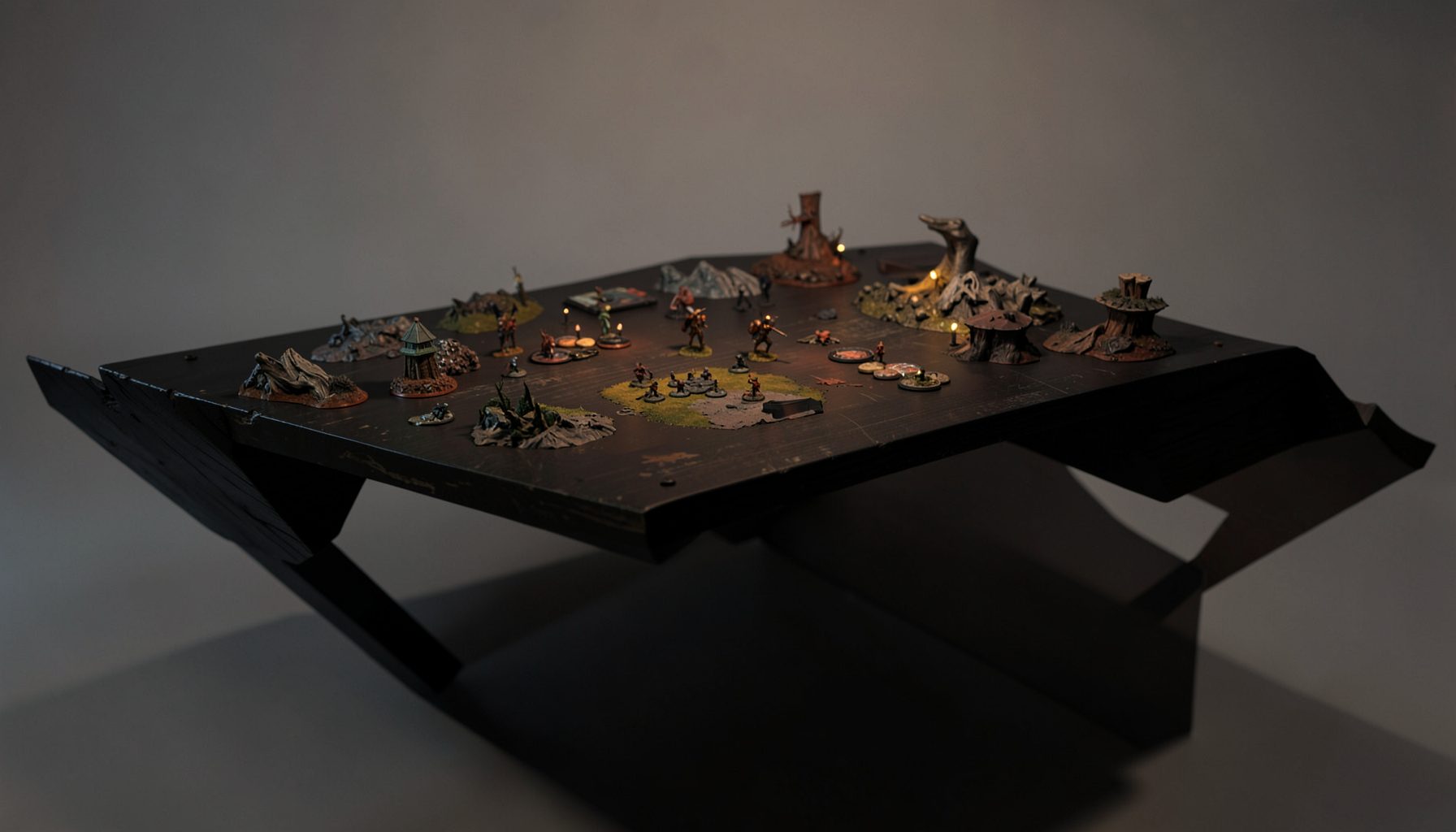
Live-streamed games, recorded matches, and event data gathered in one place.
Kill Team Stream hosts quality live streaming of Kill Team content — tournaments throughout the year on Twitch, regular games streamed to the channel, and tournament data gathered so players can see what's happening in the scene. Powered by WARHAMMER.
Browse tournamentsOfferings
Tournaments
Multiple Kill Team tournaments hosted throughout the year, all live-streamed on our Twitch channel.
Videos
Streams are recorded and uploaded to YouTube alongside original video content we produce.
Event Data
Tournament packets from past events plus resources for upcoming Kill Team tournaments.
Site Directory
Why Phobos Stealth Dominates Open Board Scenarios in Kill Team
Walk into most Kill Team open board rounds and the first thing you notice is how exposed every model looks. Without dense terrain walls and barricade lanes to duck behind, operatives are standing in wide sightlines with nowhere to vanish. Many teams struggle to make sense of this deployment, leaning on raw shooting power or trading pieces until one side cracks. The Phobos Strike Team treats that exposure as a gift. Their entire kit is engineered to thrive on a board designed to punish movement, which makes them one of the rare factions where open terrain plays directly into the kill team's hands.
Tournament organisers up and down the east coast have warmed to open board setups in recent seasons because they force honest tactical decisions. It blocks the lazy habit of camping behind a static barricade all match and rewards play that can adapt on the fly. Australian events like the Brisbane Open in Queensland and SMOG up in Sydney regularly schedule open board brackets, often streamed late on a Saturday arvo when the venue is at its hottest. The format catches a lot of rosters off guard. Phobos players, by contrast, smile when they see it on the mission card.
For anyone new to the faction, the Phobos Strike Team is the Primaris infiltration cadre of the Space Marines range, drawn from the kill-teams that strike behind enemy lines before the main assault lands. Their roster layers multiple ways to avoid being seen: camo capes, infiltrator operatives, and a host of ploys that turn the light, the distance, and the line of sight into tactical cover. Casual viewers often miss just how many silent options sit on the team's datasheet, because the strength is not obvious until you watch a competent Phobos player pilot them through an unkind board.
The argument of this piece is simple. On an open board, stealth is no longer a luxury gimmick tucked into a ploy. It is the spine of how the kill team scores, survives, and swings trades. From initial deployment all the way through the closing turns, the Phobos repertoire of concealed movement, repositioning, and concealed charges gives them levers most other factions have to fight twice as hard to pull. Understanding why that edge shows up so clearly on open terrain is essential for anyone serious about competitive play, and that is what the rest of this article walks through.
What the Open Board Actually Does to a Roster
The open board format strips the typical Warhammer Kill Team board back to its bones. Large windows of empty table sit between modest pieces of terrain, often a handful of crates, low ruins, and sparse light cover. The mission deployments then push players into wider zones than usual, which spreads models out and exposes movement options. Veteran tournament players from Melbourne's Good Games scene have described the format as "playing on a car park with a few rocks in it," which sounds harsh but captures the brutal exposure that defines the early turns.
Visibility becomes the dominant currency in such a match. Cover saves disappear, operatives cannot lean on heavy barricades for a normal save bonus, and overwatch feels dangerous in both directions because targets stay exposed for longer. Most kill teams rely on stacking saves and trades to weather that storm. Phobos instead weaponise it. Their operatives are designed to be selectively invisible, picking the moments when an opponent is allowed to see them at all. On an open board, that selective invisibility goes from being a nice trick to being the only thing keeping your operatives alive through the opening fight.
For the streaming audience watching CanCon coverage live at two in the morning local time, the result is genuinely watchable. Open boards force action. A Phobos player who understands concealment creates the kind of pushing-and-pulling match the camera loves, where models vanish behind light cover and reappear across the table to mess up plans. The format hands the faction a stage on which their lore actually reads as tactics, instead of looking like flavour text on a datasheet.
The Stealth Toolkit Carried by Phobos
The Phobos roster is unusual because almost every operative gains something from the kit, rather than stealth being locked behind a single elite. The Infiltrator Sergeants and the Infiltrator marksmen bolt on carbine-style weaponry and add camo capes that grant a free save in the right circumstances. Reivers bring grapnel launcher and combat knives that reward closing the gap in silence. Even the basic Infiltrator and Reiver operatives ship with infiltration protocols that allow them to deploy forward of the kill zone border or to set up hidden in the no man's land between forces. The ploy list then sweetens the package with the iconic Fighting in Shadows ability, which lets a friendly operative ignore the look out penalty when targeting nearby enemies.
What this means in plain English is that the team layers three different stealth systems on top of each other. First, physical concealment through camo and shielding gives a passive save. Second, the deployment tricks give board presence before the first turn. Third, the action economy of conceal versus re-positioning lets a player skip shooting turns without losing tempo. Many teams in the meta rely on one or two of those mechanisms at best, and usually only on a single operative. Phobos can field three or four stealth-ready bodies in a standard fifteen-model setup, which is why the faction feels unfair on a board with nowhere to hide.
Community breakdowns from flipperaman nerd analysis walk through the same point with charts and example turns, showing how the stack of abilities compounds over the course of a match. Once you see the team in motion, the dominance stops feeling mysterious. It feels engineered.
Infiltration as Early Board Control
The single biggest reason Phobos works on the open board is what their operatives do before round one even starts. Infiltration protocols hand the player free movement before the first activation, letting key models skip the line at the start of the fight and take up positions that other teams would have to bleed for. On a terrain-dense board, forward deployment looks risky because a clever opponent can gang up the infiltrators early. On an open board, the risk actually drops, because the table is wide enough that a charging infiltrator usually has to traverse exposed ground to reach them, buying precious time.
A common opening from experienced Phobos players is to push one infiltrator forward into the centre of the board, hide them behind light cover, and use them as a roadblock. The opponent has to either walk around them, costing activation order, or commit a melee threat to clear them. Either way, the Phobos player gets free information about the opponent's plan, and they have done so without burning a single action in the first turning point. This is the kind of tempo advantage that ripples through the rest of the match, and open boards turn it from a cute trick into a genuine early-game hammer.
Australian venues often have a habit of hosting their streamed matches on boards that mirror major international events. When the SMOG crew or the Brisbane Open crew rotate in an open setup, the audience at home can watch a Phobos player park a single Infiltrator twenty-five inches forward and refuse to be shifted. It looks absurd on camera, in the best possible way.
Concealment as a Defensive Engine
Cover saves are not the only defensive resource on the open board. Phobos turn the simple act of being unseen into a separate defensive layer that does not depend on terrain at all. A concealed operative can be targeted only with ranged attacks that ignore the conceal order, or by operatives who are also in the same drop zone, or by specific faction ploys that bypass the rule. On a board with sparse walls, those conditions are surprisingly hard to meet. Walk to where the enemy cannot see your unit, and they have to spend resources, actions, or equipment just to draw a bead on you.
The genius of the team is how conceal chains into other abilities. A concealed Infiltrator Serge can stay safely tucked behind a crate on a flank while the rest of the roster trades in the centre. Once the opponent invests the resources needed to flush that model out, the Phobos player simply uses a re-position action to swap positions, often scoring an objective in the process. The lethal sting remains at the back of the board, ready to punish anyone who overcommits. Open boards make this loop more dangerous for the opponent, because the wide distances between cover pieces force them to commit hard to any chase.
This is also where the action economy of the team shines. Conceal is one of the three standard actions a player can take, so choosing it does not lock the team out of scoring. A Phobos operative can spend an activation pushing onto an objective, then retreat out of line of sight to reset the conceal order, all without burning through the team's limited ploy pool. Few factions can claim that kind of tempo-positive defence.
Melee Threats From the Shadows
Stealth is often written off as a defensive tool. Phobos quietly turn it into an offensive one. Their Reivers carry shock grenades and combat loadouts that reward a charge out of stealth, charging up to a full distance when the operative is concealed and ignoring a penalty in the process. The same model can crouch in the open, switch to fight orders, and become a legitimate close-range threat the moment an opponent walks within charge range. On an open board, the threat radius balloons, because charging a concealed operative means running across the kind of bare ground where almost any other team would be shredded by overwatch.
The tactical effect is a reverse mind game. The opponent sees a Reiver across the table and cannot tell whether it is fishing for objectives or pre-loaded for a charge. If they ignore it, the Reiver can shift position and swing. If they chase it, they have spent an activation that could have scored on a primary objective instead. Phobos players love this kind of dilemma, and the wide open boards that Australian organisers love to schedule give them more room to drag the opponent into choices that always favour the infiltrator.
Throw in the grappling tools that some Reivers bring, and the team can hop over the same crates that defenders are using for safety, dropping into melee behind the opponent's mid-board. That kind of mid-table pressure is exactly what open boards force anyway, except most factions need to bleed models to make it happen. Phobos just walk through the gap.
When Open Board Stealth Loses Its Edge
The case for Phobos on the open board is strong, but it is not a free win. Stealth-heavy teams still get punished by kill teams that bring a lot of indirect fire, mortal wounds, or area denial tools. On an open board, indirect weapons in particular become a nightmare for any concealed operative, because the los rule does not help against a barrage that does not need a sightline. Tau and Thousand Sons lists have made a habit of cracking open Phobos games for exactly this reason in Australian competitive events.
Open boards can also hurt the team when the mission specifically rewards spread-out capture, since Phobos do better when they can wall off small sectors rather than race across a wide zone. A player who understands both the faction and the format will usually pick deployments that favour clustering on objectives, then use the board as cover. Done well, it is a different kind of dominance than the one true stealth rosters can claim, and it is also a good reason to study replays from events like the SMOG open brackets before committing to a list.
Watching the open board matchups from the recent Brisbane stream, the take-away is honestly simple. Stealth alone rarely wins a game of Kill Team. Stealth attached to a roster that knows how to leverage open sight lines, hidden positions, and forward deployment absolutely does. Phobos are the cleanest example of that lesson in the current meta, and anyone who wants to climb the competitive ladder in Australia this season should be paying close attention to how the kit works before the next tournament pack drops.
Tournament Packets
Packets from previous Kill Team events are kept here alongside new packets for upcoming tournaments, so organizers and players have what they need in one place.
View Event Data